

FOXO4-DRI Senolytic Peptide: One Mouse Paper, Nine Years of Follow-Up, and Not One Independent Replication
FOXO4-DRI is a 46-residue peptide built entirely from D-amino acids, and almost everything written about it traces back to one paper published in Cell in March 2017. That paper is real, detailed and better controlled than most of what came after it. What came after it is the problem. In nine years I could not find one published attempt by a laboratory outside the originating network to repeat the mouse aging experiments, and no published failure either. No human trial has ever been registered.
Research-use-only disclaimer: FOXO4-DRI supplied for research is intended strictly for in-vitro and laboratory research use and is not intended for human or veterinary use. The cell and animal studies below were carried out in academic laboratories and do not describe or support any use in people. Where human trials of other senolytic agents are discussed, those trials concern prescription drug products given under medical supervision. No dosing or administration guidance appears here; animal dose arms are study design facts. Nothing here is medical advice.
TL;DR
FOXO4-DRI is a 46-residue all-D retro-inverso peptide, C228H388N86O64, average mass 5358.1 Da, joining the HIV-1 TAT transduction domain to a fragment of the FOXO4 forkhead domain. It was designed to pull p53 away from FOXO4 in senescent cells so that p53 reaches the mitochondria and triggers apoptosis. The founding evidence is one paper, Baar et al., Cell 2017, reporting selectivity indices of 7.01 to 12.91 in senescent human fibroblasts and improvements in fur score, fitness and plasma urea across three mouse cohorts given 5 mg/kg intravenously on days 1, 3 and 5. No human trial has ever been registered or run. No independent in vivo replication of the aging results has been published, and no failed replication either. A 2025 structural study found the HIV-TAT segment itself binds p53, which weakens the claim that this is a clean FOXO4 mimetic. Research use only.
Identity: 46 residues, all D-amino acids, C228H388N86O64, average mass 5358.1 Da, CAS 2460055-10-9, net charge about +11.
Design: HIV-1 TAT 48-57, a PPPRKGGS linker, then a 28-residue FOXO4 forkhead fragment, synthesised in reverse.
Evidence base: One founding paper, with selectivity indices of 7.01 to 12.91 against senescent human fibroblasts.
Human data: None. A ClinicalTrials.gov query returns no FOXO4-DRI study at any phase.
Replication: No independent in vivo replication of the 2017 aging results, and no published failure either.
Mechanism caveat: A 2025 NMR and ITC study found the HIV-TAT segment contributes to p53 binding, weakening the specificity claim.
Proxofim: A vendor designation. It appears on no company page, paper or registry I could open.
Status: research use only.
What the FOXO4-DRI Peptide Is, Chemically
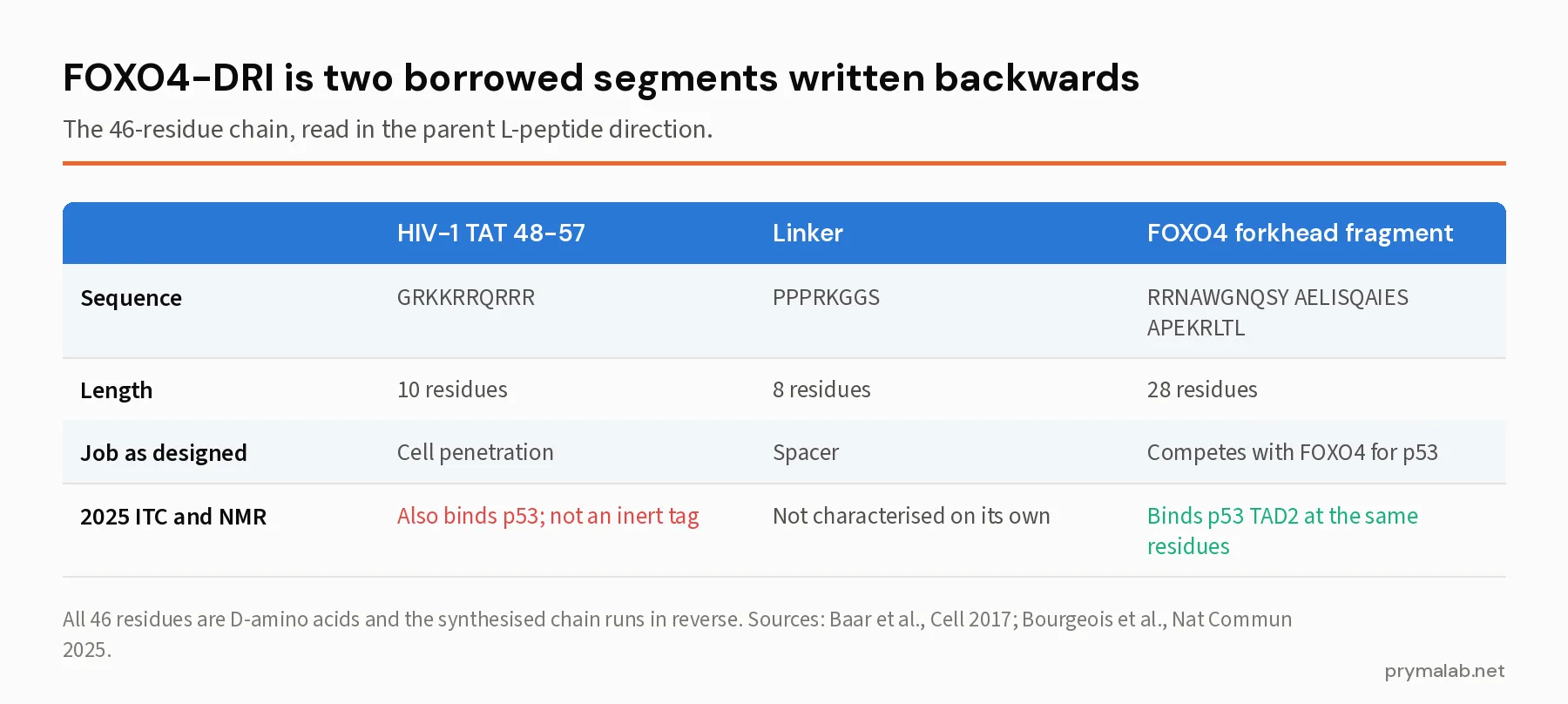
FOXO4-DRI is a synthetic 46-residue peptide made entirely from D-amino acids and synthesised in reverse relative to the sequence it imitates. No ribosome can make it, because ribosomes incorporate L-amino acids. Two borrowed segments are fused: the HIV-1 TAT cell-penetrating decapeptide and a 28-residue piece of the FOXO4 forkhead DNA-binding domain.
The sequence reported by Baar and colleagues, written N to C with lower case marking D-residues, is ltlrkepaseiaqsileaysqngwanrrsggkrppprrrqrrkkrg.[1] Reverse that string and the parent reading order appears: GRKKRRQRRR, then PPPRKGGS, then RRNAWGNQSYAELISQAIESAPEKRLTL. The first ten residues are HIV-1 TAT 48 to 57. The last 28 are the N-terminal segment of the FOXO4 forkhead domain, a region the authors describe as conserved between human and mouse but divergent from FOXO1 and FOXO3. That divergence is the entire basis of the paralogue selectivity claim.[1]
| Property | Value |
|---|---|
| Length | 46 residues, D-amino acids throughout |
| Molecular formula | C228H388N86O64 |
| Average mass | 5358.1 Da |
| CAS number | 2460055-10-9 |
| Composition | 10 Arg, 4 Lys, 3 Glu; no Asp, Cys, Met or His |
| Net charge at pH 7 | about +11 |
The length is 46, and the number you will see most often is 45
Kang and colleagues describe FOXO4-DRI as 46 amino acids.[2] I counted the printed string, then recomputed the formula and average mass from it and got C228H388N86O64 at 5358.13 Da, matching the supplier figure of 5358.1 Da.[3] The Wikipedia entry says 45 residues and then prints a sequence 46 characters long.[4] The correct number is 46, and a certificate stating 45 was copied rather than measured. One junction detail I am carrying on two sources rather than three: the linker reads PPP, where most TAT constructs run PPQ at that position. Worth checking against the paper's methods table before it reaches a label.
The charge is quoted just as loosely. The chain carries 10 arginines, 4 lysines and 3 glutamates, no aspartate and no histidine, for a net near +11 at neutral pH. Kang et al. put it at +10.99 against their shorter L-peptide at +7.99, arguing that charge density drives non-specific interaction.[2]
Why the D-amino acids are load-bearing rather than convenient
A D-retro-inverso peptide reverses the backbone direction and inverts every alpha-carbon stereocentre, so the side chains sit roughly where the parent L-peptide puts them while the backbone becomes unreadable to mammalian proteases, which are stereospecific for L-peptide bonds. The expected consequences are a longer half-life and lower immunogenicity, since MHC class II processing also depends on stereospecific proteolysis. Baar et al. published no stability data for FOXO4-DRI itself; their justification is precedent, that other DRI peptides have been tolerated and effective in clinical trials.[1] That is an argument from a class, not a measurement on this molecule.
One definitional point. The FDA draws its peptide against protein line at 40 amino acids, so a 46-mer sits on the protein side of it. That is a convention, not a regulatory finding, since no regulator has classified FOXO4-DRI at all. Our reference on where the peptide boundary sits works through why the number is 40.
The FOXO4-p53 Mechanism, and the 2025 Structure That Complicated It
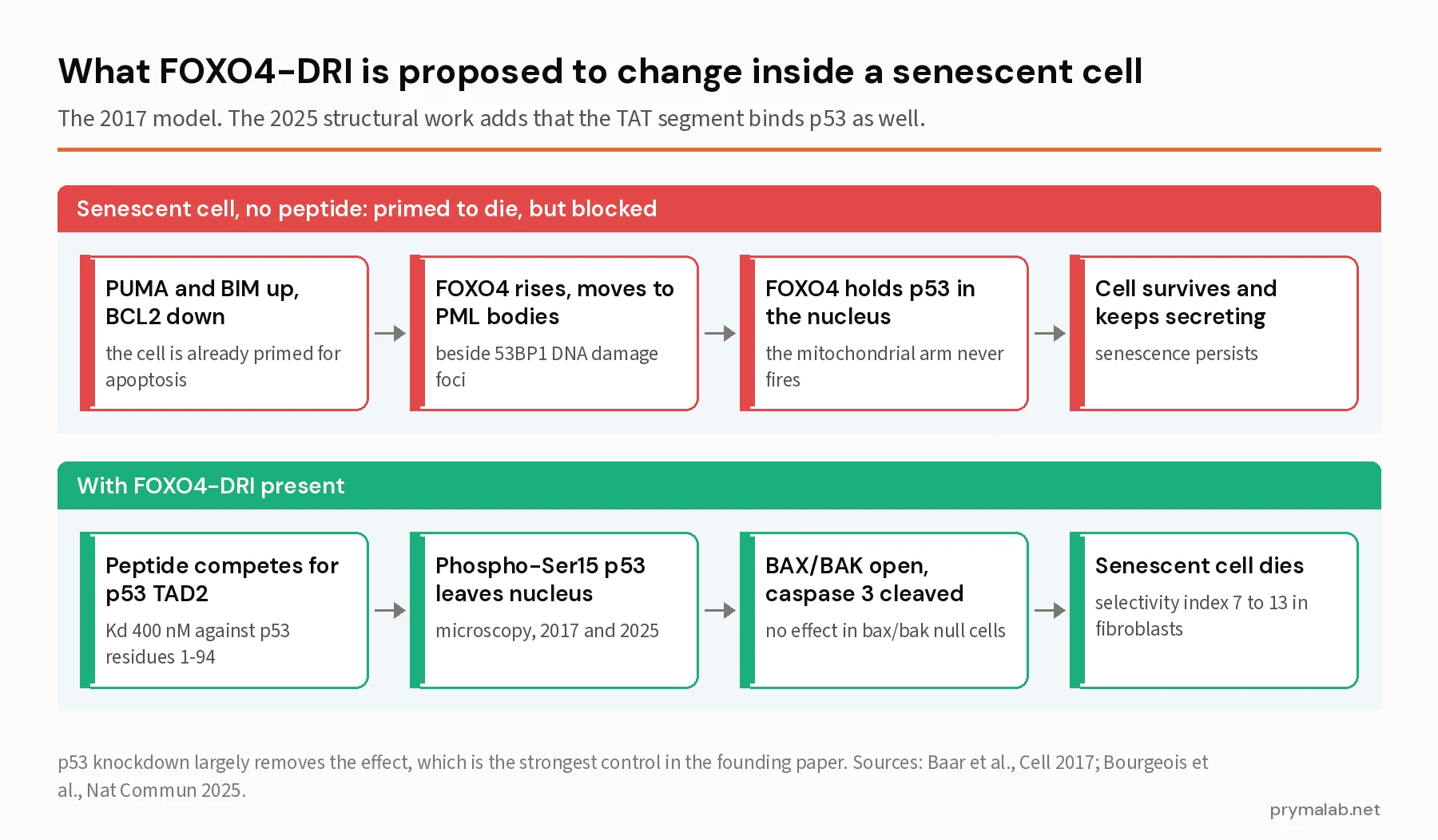
The design idea states simply. Senescent cells switch on pro-apoptotic machinery and then fail to die, so something is holding the brake. Baar and colleagues proposed that FOXO4 binds p53 and holds it in the nucleus, blocking the mitochondrial arm of p53-driven apoptosis, and that a peptide copying the FOXO4 binding surface can compete that interaction apart.[1]
The published chain of events runs like this. FOXO4 is raised in senescent cells and concentrates in PML nuclear bodies next to 53BP1-containing DNA damage foci, shown by structured illumination microscopy. FOXO4-DRI enters on its TAT segment and competes for p53. The displaced protein, specifically the active phospho-Ser15 form, leaves the nucleus and reaches the mitochondria, where it triggers BAX and BAK-dependent caspase-3 cleavage. Three genetic controls sit behind that and their quality differs: p53 knockdown substantially reduced killing of senescent IMR90 cells, and BAX and BAK dependence was shown in bax/bak null cells, while p21 merely fell after treatment and p16 was only a burden readout.[1]
What the 2025 structural work confirmed, and what it unsettled
Bourgeois and colleagues published the definitive biophysical characterisation of the axis in Nature Communications in 2025, using NMR, isothermal titration calorimetry and molecular dynamics.[5] De Keizer and Burgering are co-authors, so this is a refinement from inside the originating network rather than an adversarial check, and I weight it accordingly. The earlier review of the axis from the same Graz group gives the background.[6]
What it confirms: the FOXO4 forkhead domain binds p53 transactivation domain 2 specifically, TAD1 alone does not bind, FOXO4-DRI engages the same p53 residues as the native domain, and both partners are disordered in solution and fold together on binding.[5]
| Interaction | Kd |
|---|---|
| FOXO4-DRI with p53 residues 1-94 | 400 ± 280 nM |
| FOXO4-DRI with p53 TAD2 alone | 18.5 ± 3.6 µM |
| FOXO4-DRI with p53 TAD2, pThr55 | 5.8 ± 1.2 µM |
| FOXO4-DRI with p53 TAD2, pSer46 and pThr55 | 4.9 ± 0.3 µM |
| Native FOXO4 forkhead domain with p53 TAD2 | about 2 µM |
The 46-fold gap between binding the full p53 N-terminal region and binding TAD2 alone says the interaction is multivalent, not the clean single-site competition supplier copy describes.[5] Then the finding that changes the framing. Both the FOXO4-derived sequence and the TAT component contribute to p53 binding, so the HIV-TAT segment has roles beyond uptake.[5] A highly cationic decapeptide that engages an acidic, disordered transactivation domain is a plausible source of promiscuous binding to other acidic disordered regions. FOXO4-DRI is therefore not a pure FOXO4 mimetic, and the delivery tag cannot be swapped for a gentler carrier without changing the pharmacology.
Two further results are worth carrying. Adding DNA competes with p53 binding to the forkhead domain, so the interface overlaps the DNA-binding surface. And affinity rises several-fold when p53 carries Ser46 and Thr55 phosphorylation, the best physical explanation for senescence selectivity produced since 2017, and one that makes selectivity graded rather than absolute.[5]
Baar 2017: What the Founding Paper Measured, and What It Did Not
Baar et al., Cell 2017, is the source of essentially every claim made about FOXO4-DRI. It reported selective killing of senescent human fibroblasts, three mouse cohorts, and one genetic control experiment stronger than anything published since. It did not report survival, plasma half-life, tissue distribution or a toxicology panel. The author list includes Judith Campisi and Jan Hoeijmakers, so this was not a lone-laboratory result.[1]
The in vitro work, and the concentration problem inside it
Senescence was induced in IMR90 human fetal lung fibroblasts by 10 Gy of ionising radiation or by doxorubicin at 0.1 µM given twice with a two-day interval and analysed seven days later. WI-38, BJ, NIH 3T3, HEK293LTV and BMK cells were also used. The tested range was 5 to 50 µM.[1]
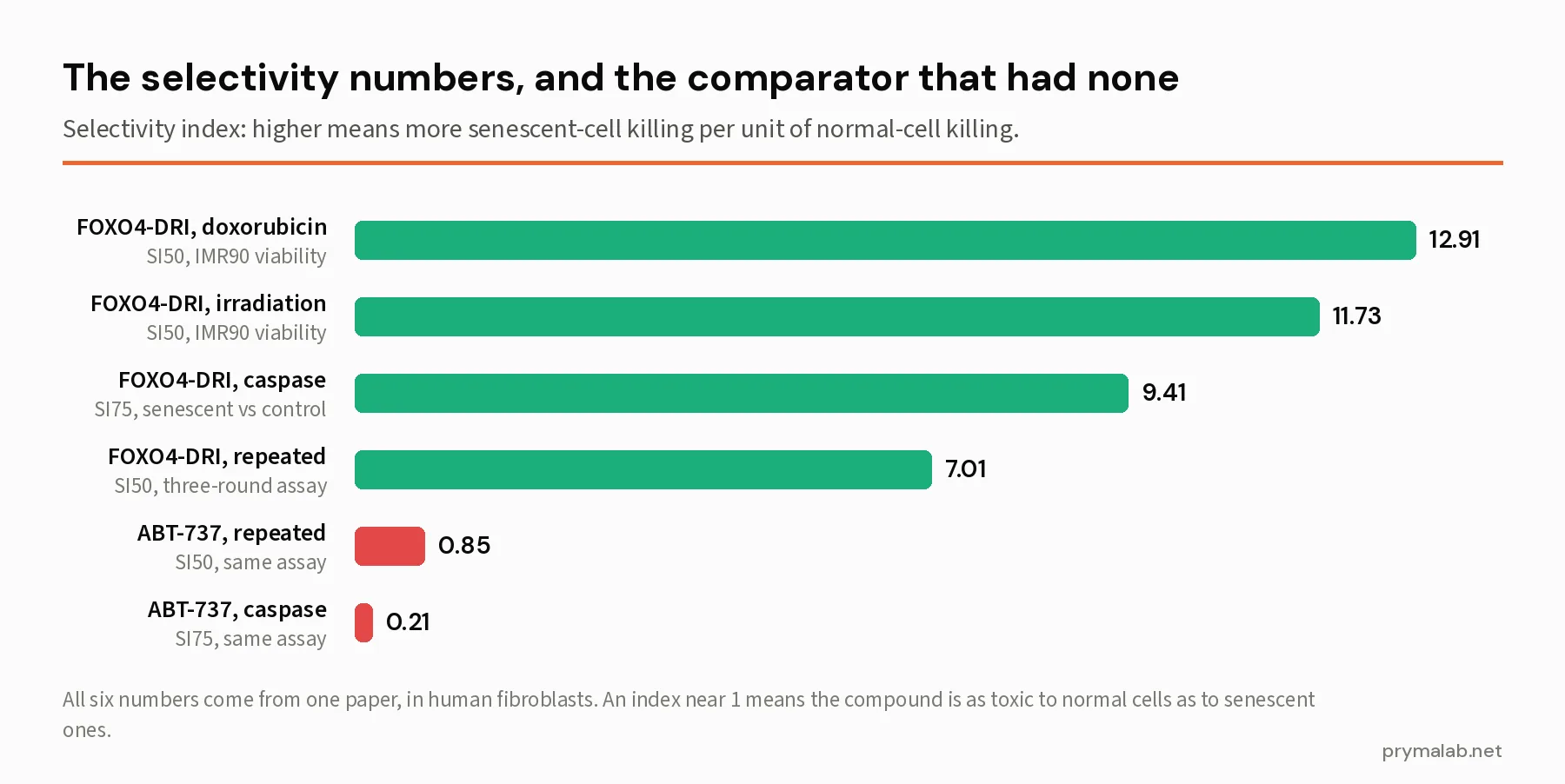
The ABT-737 comparison is the strongest rhetorical point in the paper, and a fair one. In the same assays where FOXO4-DRI returned 9 to 13, a BCL-2 and BCL-xL inhibitor returned 0.21 and 0.85, meaning it was as toxic to normal cells as to senescent ones.[1]
Three mouse cohorts, one route, and the endpoints that get misquoted
The canonical regimen is intravenous, not intraperitoneal. The figure legends specify three intravenous doses at 5 mg/kg every other day, on days 1, 3 and 5, for all three cohorts, with intraperitoneal delivery only in the ganciclovir co-treatment arms.[1] Most follow-up work switched to intraperitoneal without anyone publishing bridging data. Whether cycles repeated beyond days 1, 3 and 5 in the longer progeroid experiments I could not confirm, and I am flagging that rather than guessing.
| Cohort | Animals | Reported outcomes |
|---|---|---|
| Doxorubicin chemotoxicity | C57BL/6J, 10 to 40 weeks | Weight loss about 11% on doxorubicin alone against about 2% with peptide; plasma AST rise of roughly 300 to 400% counteracted. Plasma urea difference not significant. |
| XpdTTD/TTD progeroid | 26 to 60 weeks | Fur score up; abdominal temperature normalised; running wheel activity up in most animals; plasma urea normalised (n = 7 to 8); kidney IL-6 down and LMNB1-positive nuclei normalised. |
| Naturally aged wild-type | 115 to 130 weeks | Plasma urea and creatinine each down by roughly 50%, read from figures. Fitness and fur scores up, p16 bioluminescence down. Running wheel not reported: variation too large. Group sizes not stated. |
Two entries there are routinely mis-stated elsewhere. The renal endpoints are plasma urea and creatinine, not urinary albumin, so any page reporting reduced urinary albumin describes a measurement this paper did not make. And the restored running wheel activity attributed to aged mice comes from the progeroid cohort only, where the wild-type baseline was 9.37 ± 1.1 km per day against 1.37 ± 0.54. In the naturally aged animals the authors wrote that the variation in running wheel activity was too large to perform meaningful experiments. The fur score is a subjective 0 to 4 ordinal scale with no blinding statement I could find, though infrared abdominal temperature corroborates the same phenotype.[1]
The experiment that carries the most causal weight
In progeroid and aged mice crossed to a p16 reporter carrying herpes thymidine kinase, ganciclovir-driven ablation of p16-high cells and FOXO4-DRI treatment produced comparable reductions in plasma urea and creatinine.[1] An agent that phenocopies targeted genetic senescent-cell ablation is real evidence that it works through clearance rather than something incidental. Nine years on, that remains the best causal argument published for this molecule.
Nine Years of Follow-Up, and Not One Direct Replication
I could not find a published attempt by a laboratory outside the originating network to repeat the progeroid or naturally aged mouse experiments, and no published failure either. What exists instead is a body of new applications in new disease models, concentrated in a handful of Chinese research groups, all positive.
| Study | Model and design | Reported result | Verification |
|---|---|---|---|
| Chondrocytes, Front Bioeng Biotechnol 2021 | Culture-expanded human chondrocytes, 25 µM for 5 days | Removed over 50% of cells at PDL9, no significant effect on PDL3. SA-β-gal fell from over 40% to under 5%. | Full text read |
| Leydig cells, Aging 2020 | 20 to 24-month mice, 5 mg/kg intraperitoneally, three doses | Serum testosterone up; testicular SA-β-gal down; apoptosis in senescent TM3 cells from 10% to 27%. | Full text read |
| Spermatogenesis, Exp Gerontol 2024 | Aged mice, Leydig cell SASP | Improved spermatogenesis, per the title | Unverified |
| Pulmonary fibrosis, 2022 | Bleomycin-induced fibrosis in mice | Myofibroblast targeting, per the title | Unverified |
| Keloid fibroblasts, Commun Biol 2025 | Single-cell analysis of keloid tissue | Apoptosis and nuclear export of phospho-Ser15 p53 | Full text read |
| Endothelial senescence, 2025 | Aged and D-galactose-treated mice | Lower ROS and SASP markers, improved aortic function | Unverified |
The chondrocyte work is the most useful item there, for a reason unrelated to its headline.[7] It tested culture-expansion senescence, a stimulus the founding paper never used, and gave the clearest independent demonstration of concentration-matched selectivity published: over half the senescent population removed, the minimally expanded population left alone. Those authors also reported raised p21 after treatment and wrote that the potential adverse influence of senolytics needs further investigation.
The Leydig cell work matters for its route substitution and one typographical trap.[8] Its in vitro concentration is printed as 25 mM, certainly meant to be 25 µM, since 25 mM of a 5.36 kDa peptide is about 134 mg/mL. The authors were candid: the mechanism of the testosterone increase was not elucidated, and they called for evaluation of muscle toxicity, particularly cardiotoxicity, because FOXO4 is expressed in muscle. Two further reports, on spermatogenesis and on bleomycin-induced pulmonary fibrosis, sit behind publisher blocks and I list them without endorsing their numbers.[9][10] The keloid work is open and consistent with the 2017 model.[11] A 2025 report on endothelial senescence I could reach only through secondary summaries, so its numbers stay out.[12][13]
The second-generation peptides, and what their designers say about FOXO4-DRI
The most informative follow-up comes from groups building competitors, because they had every incentive to benchmark the original honestly. ES2 came out of an Oregon Health and Science University-led group with no stake in FOXO4-DRI. They modelled the FOXO4-TP53 interface to design shorter disruptors; ES2 broke up FOXO4-TP53 complexes, activated apoptosis in senescent cancer cells, improved survival alongside BRAF inhibitors in melanoma models, and reduced liver senescent cells in aged mice.[14] That is the closest thing to independent validation that the target is druggable. It is not validation of the molecule itself, and I could not retrieve the full text, so the potency comparison remains unverified here.
CPP-CAND came from a Korean group in 2025: L-peptides from p53 transactivation domain residues 42 to 57, TAT-fused into a 28-residue construct. Benchmarked against FOXO4-DRI in doxorubicin-senescent A375 melanoma cells, it showed comparable SI50 and roughly 1.2 to 1.6 times higher selectivity at SI75.[2] Their criticisms are worth reading directly: that targeting p53 presents a substantial risk of off-target effects because p53 has hundreds of interaction partners, and that production cost is relatively high due to its long length and the requirement for D-type amino acids. The field has converged on shorter L-peptides, and nobody has published a better version of FOXO4-DRI itself.
FOXO4-DRI Human Trials: None Have Been Registered or Run
There are none. Not a phase 1, not a first-in-human safety study, not an investigator-initiated trial. A ClinicalTrials.gov query for FOXO4 returns exactly one study, and it is not about this molecule.
Two independent reviews agree. A 2026 Antioxidants review states that FOXO4-DRI has not been evaluated in human trials and that its evidence base remains preclinical.[15][16] A 2025 review in the Journal of Translational Internal Medicine classifies it at preclinical stage.[17]
The 2026 brain-aging review, and why I am not repeating its claims
One 2026 narrative review makes claims that have started circulating: that FOXO4-DRI in animal models restored cerebral blood flow and blood-brain barrier integrity, reversed hippocampal atrophy, improved cognition, and cleared amyloid-beta and tau in Alzheimer's and tauopathy models.[18]
I could not locate primary sources tied to FOXO4-DRI for any of those claims, and the review provides no blood-brain barrier data, no pharmacokinetics and no toxicity data. Several of the listed effects belong to senolytics as a class in transgenic models rather than to this peptide. A 5.36 kDa molecule carrying a +11 charge crossing the blood-brain barrier is a strong claim needing direct evidence, and there is none. I would not build anything on it.
The distance to a first human study is larger than the missing registration suggests. There is no toxicology package for FOXO4-DRI, no immunogenicity data in any species, and no pharmacokinetic data at all. The GLP toxicology completed in 2025 by the company founded on this chemistry was run on CL04183, a different molecule.
Senolytic Peptides Against the Small Molecules: Where FOXO4-DRI Sits
FOXO4-DRI is the only designed peptide among the senolytics discussed seriously, and the only one of the four here with no human data at all. Dasatinib plus quercetin has the most human evidence and the least mechanistic precision. Navitoclax has the most potency and the most dose-limiting toxicity.
| Agent | Class | How it kills senescent cells | Human data | Main liability |
|---|---|---|---|---|
| FOXO4-DRI | Designed D-retro-inverso peptide | Disrupts FOXO4-p53, freeing p53 to the mitochondria | None | No PK, no toxicology, a roughly 10-fold selectivity window |
| Dasatinib + quercetin | Repurposed kinase inhibitor plus a flavonoid | Broad, poorly defined survival-pathway interference | Open-label pilots only | Small uncontrolled trials; no functional change in dementia |
| Fisetin | Flavonoid | Poorly defined | Trials run, including COVID-FIS | Weak potency and weak target definition |
| Navitoclax (ABT-263) | BCL-2 and BCL-xL inhibitor | On-target inhibition of the apoptosis brake | Oncology trial data | Dose-limiting thrombocytopenia, plus neutropenia and bleeding |
The human record for dasatinib plus quercetin is worth stating precisely, because it gets borrowed to support peptide senolytics. An open-label first-in-human pilot in 14 patients with idiopathic pulmonary fibrosis, NCT02874989, reported improvements in physical function, and a phase 1 study in diabetic kidney disease, NCT02848131, reported reduced senescent cell burden in skin and adipose tissue.[17] Both are small, open-label and uncontrolled, so they evidence biological engagement rather than clinical benefit. In dementia, NCT04063124 found dasatinib reached cerebrospinal fluid in 4 of 5 participants while quercetin did not, with no cognitive or imaging change, and a second pilot, NCT05422885, showed no functional change.[19] Those are prescription drug products given under medical supervision, and they say nothing about research-grade material.
The single most favourable comparative result FOXO4-DRI has is the ABT-737 head-to-head inside Baar et al., where the BCL-2 family inhibitor returned 0.21 to 0.85 against the peptide's 9.41.[1] Navitoclax is ABT-737's clinical analogue, and its dose-limiting thrombocytopenia is on-target platelet BCL-xL inhibition. As the 2026 Antioxidants review puts it, findings from dasatinib plus quercetin cannot be transferred to a peptide that disrupts FOXO4-p53.[16]
Read beside our reference on Epitalon, telomerase and cellular aging, the two literatures address different problems. Telomere maintenance is about replicative capacity in dividing cells. Senolysis is about removing cells that have already stopped.
FOXO4-DRI Side Effects, and the Toxicology That Was Never Run
There is no side effect profile for FOXO4-DRI in the ordinary sense, because no human has been dosed in a registered study and no formal toxicology package exists. What exists is a short set of observations made inside mouse efficacy experiments, plus theoretical risks that follow from the mechanism. Anyone quoting FOXO4-DRI side effects as a known list is quoting something nobody has measured.
What the founding paper reported, and the limits of that claim
Baar et al. describe the peptide as well tolerated in vivo under the conditions tested: no noticeable effect on platelet levels or other whole-blood values, a deliberate contrast with BCL-2 family inhibitors and their on-target thrombocytopenia; no deleterious effects on heart tissue; no predisposition of healthy cells to acute DNA damage; and no sensitisation to doxorubicin.[1]
Read the conditions rather than the conclusion. Three doses. A 30-day window. Cohorts of 7 to 8 animals where numbers were reported. No formal toxicology, no histopathology panel, no repeat-cycle dosing, no maximum tolerated dose. Well tolerated here means no gross problem in a short efficacy study, which is not toxicologically characterised.
Later work adds three flags. The Leydig cell group called for evaluation of muscle toxicity, particularly cardiotoxicity, because FOXO4 is expressed in muscle, and that study has never been done.[8] The chondrocyte group reported raised p21 after treatment.[7] And the CPP-CAND designers argue the risk has a direction: their peptide binds FOXO4, whereas FOXO4-DRI binds p53, and binding a master tumour suppressor carries a substantial risk of off-target effects.[2]
One claim I want to retire. A 2023 study showing FOXO4-DRI toxicity to non-senescent cells circulates in summaries, and I could not locate any such paper. The point survives without it: selectivity indices of 9 to 13 mean non-senescent cells die at roughly ten times the senescent-cell effective concentration. Selectivity is a window, not an absolute.
The theoretical risks, stated as theory
The mechanism is forced activation of the mitochondrial arm of p53, the central node of apoptosis and genome surveillance, so systemic p53 de-repression in non-target tissue is the obvious liability. There is a stranger second direction. Because the peptide acts through p53, cells with mutant or absent p53 are refractory, so it would spare p53-mutant cells while killing p53-competent ones. That is a selection pressure with an unhelpful direction, and the oncology programs now exploit it deliberately.
Senescent cells are also not uniformly harmful. Sentinel p16-positive cells in the lung basement membrane were described in Science in 2021 as a reparative niche, and I have that result at title level only.[20] FOXO proteins are lineage-restricted redundant tumour suppressors with context-dependent roles, and FOXO4 overexpression can itself induce apoptosis, so the target is not a clean pro-survival node in every tissue.[21] The TAT segment carries the generic cationic peptide liability for non-specific membrane activity at high concentration, amplified by the +11 charge. No chronic dosing study exists at all.
The pharmacokinetic record, which is empty
| Parameter | What is published |
|---|---|
| Plasma half-life | Nothing. Not in the founding paper, not in any follow-up I read |
| Biodistribution | Nothing. Target engagement was inferred from downstream tissue effects |
| Renal handling | Nothing, despite kidney being the expected elimination route and the main efficacy readout |
| Blood-brain barrier penetration | Nothing |
| Immunogenicity, anti-drug antibodies | Nothing, in any species |
Half-life figures do circulate on retail peptide sites, sometimes to one decimal place. I could not find a primary study behind any of them, and I am not going to repeat a number I cannot source. The 2026 Antioxidants review lists the same gaps as prerequisites for translation, from pharmacokinetics through to repeated-dose safety.[16]
FOXO4-DRI is not an approved medicine in any jurisdiction, no regulator has reviewed it, and in the United States it is supplied and studied as a research compound rather than a drug. Rules differ elsewhere and change; our reference on whether peptides are legal separates the four questions people usually merge into one.
Proxofim, Cleara Biotech, and the Names That Do Not Check Out
Proxofim appears on a long list of vendor pages as the clinical or development name for FOXO4-DRI, and I could not verify it anywhere outside peptide retail. It does not appear on Cleara Biotech's own website, in any peer-reviewed paper I opened, or in any registry I searched. It is a vendor designation of unverified provenance. I could not run a dedicated nonproprietary name search, so this is absence of evidence rather than proof.
What Cleara Biotech is actually developing
Cleara Biotech B.V. is the Utrecht company founded by Peter de Keizer to translate the UMC Utrecht work, with a 2.5 million dollar seed round in September 2022 and academic partners at UMC Utrecht, UMC Groningen and Graz.[22][23] Its disclosed pipeline does not include FOXO4-DRI.
The named candidates are CL04177 and CL04183, nominated in 2021 and 2022, with CL04183 advanced to development candidate in 2023. The company describes them as peptide-based compounds that selectively induce apoptosis in cancer cells with impaired p53, agnostic of the mutation site, aimed at metastatic colorectal cancer and triple-negative breast cancer. GLP toxicology in rats and non-human primates completed in 2025, GMP drug substance is done, and European regulatory guidance obtained. No trial timeline is stated and no trial has started.[22]
The company founded on this chemistry has moved from senolysis for aging to p53 restoration for oncology, and from its founding peptide to distinct molecules whose relationship to it is undisclosed. An independent observer reached the same reading in February 2026, describing Cleara as a going preclinical concern focused more on the FOXO4-p53 interaction than on FOXO4-DRI.[13]
How FOXO4-DRI Is Characterised, and Why Mass Spectrometry Cannot Tell D From L
A certificate of analysis for an all-D 46-mer has a problem the two standard assays cannot solve between them. Reversed-phase HPLC gives the purity figure and mass spectrometry confirms the mass, but D and L amino acids are enantiomers, so an all-L peptide of the same sequence has an identical formula, an identical exact mass and an identical fragmentation pattern, and on an achiral column the two co-elute. I am reasoning from stereochemistry rather than citing a study on this peptide, because I could not find one.
Two assays do answer it. Chiral amino acid analysis, meaning acid hydrolysis then derivatisation with a chiral reagent and chromatographic separation of the D and L forms, reports stereochemical composition directly. Circular dichroism is the fast orthogonal check: enantiomeric peptides give mirror-image CD spectra, so all-D and all-L preparations of one sequence differ by sign alone. Neither appears on most certificates.
That matters more here than for a typical research peptide, because the founding paper's own control says the L-version is inactive.[1] A stereochemically wrong batch would pass HPLC and MS and fail biologically, and the experiment would read as a failed replication.
What the synthesis actually risks
A 46-mer built from D-amino acid building blocks by solid-phase synthesis is demanding, and competing groups cite the cost as a liability.[2] The realistic impurity class is deletion sequences and incomplete couplings rather than stereochemical error. Those change the mass, so mass spectrometry catches them, which is the argument for insisting on a spectrum rather than a stated mass. Arginine is among the harder residues to couple cleanly and this sequence carries ten, including a run of three inside the TAT block.
The degradation chemistry follows from the sequence, and the composition here is kinder than it might be. No cysteine, so no disulfide scrambling. No methionine, so no sulfoxide formation. No aspartate, so no Asp-Gly isomerisation. The chain does carry one Asn-Gly motif, the classic deamidation and succinimide hotspot in solution, plus one tryptophan and one tyrosine, both oxidation-prone. No published stability study exists as far as I can tell, so treat that as inference from structure rather than a shelf-life claim.
The counterion arithmetic is worse than usual here. A peptide with 14 basic residues binds a lot of trifluoroacetate, and TFA plus residual water make up a fraction of vial mass that neither HPLC purity nor MS identity sees. If you have not worked through why a vial labelled 10 mg at 98% purity holds less than 10 mg of peptide, that arithmetic is in our reference on peptide purity testing, and the general handling case is in our references on peptide storage and stability and reconstitution. PrymaLab supplies FOXO4-DRI for laboratory research use with HPLC purity and mass spectrometry identity on every lot.
What This Article Does Not Settle
Whether the 2017 mouse results replicate. No laboratory outside the originating network has published an attempt at the progeroid or naturally aged experiments, and none has published a failure. A literature made of positive new applications tells you the molecule does something in new models; it does not tell you the original effect sizes hold.
What the working concentration means. A 5 to 50 µM working range against a 400 nM binding constant is a gap of one to two orders of magnitude. Poor intracellular delivery, rapid degradation and non-specific cationic membrane effects are all live explanations, and nobody has published the experiment that separates them.
Whether selectivity holds outside the types tested. Radiation-induced, doxorubicin-induced and spontaneous aging senescence were tested in 2017, and culture-expansion senescence in 2021. Oncogene-induced senescence has not been tested as far as I can determine, and it is the subtype where clearing senescent cells would most plausibly do harm.
What happens on repeated exposure. There is no chronic dosing study, no immunogenicity data in any species, and no formal toxicology package. The cardiac and muscle toxicity question raised in 2020 has never been investigated as far as I can tell.
Whether the peptide reaches the brain. A 2026 review asserts a list of central nervous system effects. There is no blood-brain barrier penetration data for a 5.36 kDa peptide carrying a +11 charge, and I could not locate primary sources for the claims.
What is well established: the sequence, formula, average mass and net charge; that the L-amino acid version is inactive; the in vitro selectivity indices and mouse endpoints as the founding paper reported them; that the HIV-TAT segment contributes to p53 binding; and that no human trial of FOXO4-DRI has ever been registered.
Frequently Asked Questions
Is FOXO4-DRI FDA approved?
No. FOXO4-DRI is not approved by any regulator, has no registered clinical trial, and is supplied for laboratory research use only.
Have there been any FOXO4-DRI human trials?
None have ever been registered or run. The only FOXO4 study in the registry is a lymphoma trial where the protein appears as a biomarker.
Is Proxofim the same thing as FOXO4-DRI?
Vendors use Proxofim for FOXO4-DRI, but the name appears in no company document, paper or registry I could open. Treat it as unverified.
What is the FOXO4-DRI peptide sequence and how long is it?
46 residues, all D-amino acids: HIV-1 TAT 48-57, a PPPRKGGS linker, and a 28-residue FOXO4 forkhead fragment. Formula C228H388N86O64, 5358.1 Da.
How is FOXO4-DRI supposed to kill senescent cells?
By competing with FOXO4 for p53, so that active p53 leaves the nucleus and triggers BAX and BAK-dependent apoptosis. Cells without p53 are largely unaffected.
Why is FOXO4-DRI made from D-amino acids?
For protease resistance, and because it is required for activity. The same sequence made from L-amino acids did nothing to senescent cells.
What are the known FOXO4-DRI side effects?
None are characterised. Mouse studies used three doses and a 30-day window, and later authors flagged possible cardiac toxicity that was never investigated.
Has FOXO4-DRI been independently replicated?
Not the mouse aging results. One independent 2021 chondrocyte study supports in vitro selectivity, and two competing peptides validate the target, not the molecule.
How does FOXO4-DRI compare with dasatinib and quercetin?
Dasatinib plus quercetin has small open-label human studies and a vague mechanism. FOXO4-DRI has a precise mechanism, better in vitro selectivity, and no human data.
Does FOXO4-DRI work orally?
No. There is no oral study, and a 46-residue polycation will not survive the gut intact. Every animal study used injection.
References
- Baar MP, Brandt RMC, Putavet DA, et al. Targeted Apoptosis of Senescent Cells Restores Tissue Homeostasis in Response to Chemotoxicity and Aging. Cell. 2017;169(1):132-147.e16. PMID 28340339. Sequence, selectivity indices, the L-peptide control and the mouse cohorts. Cell; open text at eScholarship
- Kang D, Lim Y, Ahn D, Lee J, Park C-J. Peptide Inhibitors Targeting FOXO4-p53 Interactions. J Med Chem. 2025;68(15):15683-15694. CPP-CAND benchmarking, the 46-residue count and net charge. PMC
- BOC Sciences product data. CAS 2460055-10-9, formula and average mass. BOC Sciences
- Wikipedia entry for FOXO4-DRI. Corroborates the sequence; its stated length of 45 does not match the 46 characters it prints. Wikipedia
- Bourgeois B, Spreitzer E, Platero-Rochart D, et al. The disordered p53 transactivation domain is the target of FOXO4 and the senolytic compound FOXO4-DRI. Nat Commun. 2025;16(1):5672. Binding constants and the HIV-TAT contribution. Nature Communications
- Bourgeois B, Madl T. Regulation of cellular senescence via the FOXO4-p53 axis. FEBS Lett. 2018;592:2083-2097. doi:10.1002/1873-3468.13057. Publisher blocked; background only.
- Front Bioeng Biotechnol. 2021;9:677576. Chondrocytes at 25 µM, and the caution about raised p21. Frontiers
- Zhang C, et al. Aging (Albany NY). 2020;12(2):1272-1284. Aged mouse Leydig cells; the cardiotoxicity call. Aging
- FOXO4-DRI improves spermatogenesis in aged mice through reducing senescence-associated secretory phenotype secretion from Leydig cells. Exp Gerontol. 2024. Title only. ScienceDirect
- FOXO4 peptide targets myofibroblast, ameliorates bleomycin-induced pulmonary fibrosis in mice through ECM-receptor interaction pathway. 2022. PMC9170815. Title only.
- Kong Y-X, et al. Keloid senescent fibroblasts and FOXO4-DRI-driven nuclear export of phospho-Ser15 p53. Commun Biol. 2025. doi:10.1038/s42003-025-07738-0. PMC
- FOXO4-DRI regulates endothelial cell senescence via the p53 pathway. 2025. PMC12852416. Primary text not retrieved; secondary summaries only.
- Fight Aging!, People Are Still Working on the Senolytic Peptide FOXO4-DRI, February 2026. Secondary summary of the endothelial work. Fight Aging!
- Le HH, Cinaroglu SS, Manalo EC, et al. Molecular modelling of the FOXO4-TP53 interaction to design senolytic peptides. EBioMedicine. 2021;73:103646. PMID 34689087. ES2; full text blocked. PubMed
- ClinicalTrials.gov API v2 query for FOXO4, run 13 September 2026, returning NCT07494565 as the only record. ClinicalTrials.gov
- Mateescu et al. Antioxidants. 2026;15(7):842. States that FOXO4-DRI has not been evaluated in human trials. MDPI
- Fu TE, Zhou Z. J Transl Intern Med. 2025;13(1):33-47. doi:10.1515/jtim-2025-0005. Classifies FOXO4-DRI as preclinical; source for the D+Q pilots and navitoclax toxicity. PMC
- Alameen AA, Al-Kuraishy HM, Fawzy MN, Batiha GE-S. Targeting the FOXO4-p53 axis by retro-inverso peptide senolytic agents. Naunyn Schmiedebergs Arch Pharmacol. 2026;399:14659-14676. Narrative review; claims flagged unverified. Springer
- Review of senolytic trials in neurodegeneration, covering NCT04063124 and NCT05422885. PMC13334145
- Sentinel p16INK4a-positive cells forming a reparative niche in the lung basement membrane. Science. 2021. doi:10.1126/science.abf3326. Publisher blocked; title level only.
- Liu W, Li Y, Luo B. Current perspective on the regulation of FOXO4 and its role in disease progression. Cell Mol Life Sci. 2020;77:651-663. FOXOs as redundant tumour suppressors. Springer
- Cleara Biotech B.V. company and business progress pages, retrieved 13 September 2026. CL04177, CL04183 and the GLP toxicology completion. Cleara Biotech
- Business Wire. Cleara Biotech Raises $2.5 Million in Seed Financing. 27 September 2022. Business Wire
Figures come from the published papers, company documents and the trial registry, current to 13 September 2026. Where a source could not be retrieved, or a number could not be traced to a primary paper, that is stated in the text.
Final disclaimer: This article is an educational research reference on the chemistry, proposed mechanism and preclinical record of FOXO4-DRI. Compounds supplied by PrymaLab are sold and studied for laboratory research use only and are not approved by any regulator for human or veterinary use. Statements have not been evaluated by the FDA. Nothing here is medical advice or a treatment claim.
Human trials of other senolytic agents are described for scientific context only, and do not describe or support any use of research-grade material. Animal dose arms are study design facts. Always verify the legal status of any research compound in your jurisdiction before purchase or use.